Video is gradually becoming one of the most operationally critical communication methods for an enterprise.
From product onboarding to customer education, internal training, investor communication, sales enablement, compliance updates, and support documentation, everything relies on video as the default format to communicate.
However, most video production workflows are designed for the traditional era, which means longer timelines, specialized editing teams, and misaligned content produced in volumes. As AI begins to reshape all sorts of operations in an organization, video editing cannot operate in a vacuum. Not just by helping editors work faster, AI is also changing how production workflow is staffed, managed, localized, reviewed, and scaled.
Let’s take a look at the operational shifts driven by AI in enterprise video production.
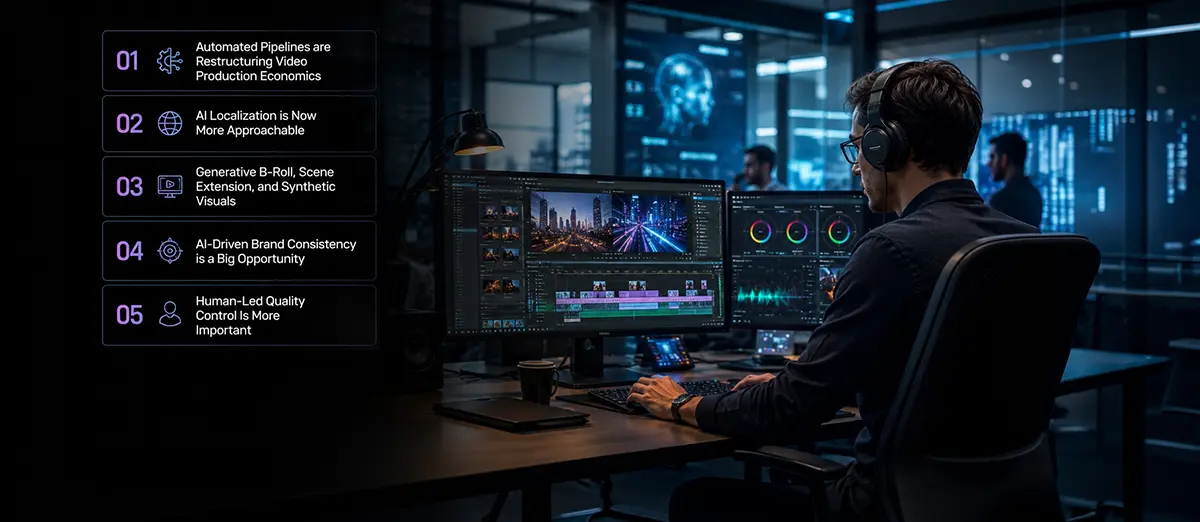
Trend 1 – Automated Pipelines are Restructuring Video Production Economics
For years, post-production has been one of the most resource-heavy parts of video creation. Not because every task demanded creative thinking, but because editors spent a large portion of their time on repetitive production work.
But this is changing in 2026, as today AI-assisted tools can handle the majority of the mechanical layering work post-production. This includes
- Rough cuts and timeline assembly
- Silence and pause removal
- Filler-word cleanup
- Multicam synchronization
- Transcript-based editing
- Basic sequencing and formatting
- Auto-captioning and metadata generation
Tools like Descript and FireCut allow editors to automate the entire workflow and not only edit videos using AI. However, this is not the only impact AI video editing delivers.
Saving the editor’s time is great, but for enterprises, this improves production capacity without increasing operational costs.
Consider this
| Traditional Workflow | AI-Assisted Workflow |
| ~8 hours to edit a standard business video | ~3–4 hours for the same output |
| Limited publishing flow | Higher publishing frequency |
| More content requires more headcount | Existing teams can support larger content volumes |
This matters even more when working in volumes. Imagine editing 20 videos per month and then seeing how the savings compound quickly. A few hours saved on every video editing translates to more than 80 hours of reclaimed production hours.
So, a team that now edits faster without degrading quality can deliver more work without expanding its size, making it a win-win for everyone.
However, remember AI cannot take over editorial judgment. That human connection, creative direction, storytelling prowess, pacing, and ensuring brand consistency still require human oversight.
Trend 2 – AI Localization is Now More Approachable
Multinational organizations had one constraint when trying to make localized videos, and that is the cost of production.
From translating to subtitling, dubbing, reviewing, and more, this process repeats. For every language, you require specialized vendors and extended timelines, not to mention a significant budget.
AI is changing this equation.
Today, we have AI localization platforms excelling at accurate subtitling, dubbing, and voice synthesis covering more than 130 languages.
The process that used to take weeks is now achievable in hours, and this convenience is not the biggest advantage; it’s the market reach you can get now.
Consider this
| Traditional Localization Model | AI-Assisted Localization |
| High per-language production cost | Lower marginal localization cost |
| Selective localization only | Broader multilingual coverage |
| Weeks of turnaround time | Same-day or next-day deployment |
| Difficult to maintain content updates | Easier ongoing content refreshes |
This matters more for organizations managing high-volume video production workflows, including:
- Product walkthroughs
- Customer onboarding libraries
- Internal training modules
- Technical support videos
- Compliance and policy communication
- Employee enablement content
Without localization, a large part of this content may remain inaccessible to your customers and teams across the globe.
Localization for better understanding and impact is a part of the process, but these are also required for compliance. As per the World Wide Web Consortium, captions, subtitles, and accessible media experiences are required from enterprises across all their communication channels.
Trend 3 – Generative B-Roll, Scene Extension, and Synthetic Visuals
One of the biggest constraints in enterprise video production has traditionally been asset dependency as editing teams have to wait for:
- Missing footage
- Product reshoots
- Suitable B-roll libraries
- Location-specific visuals
- Updated product screenshots
- Approved brand assets
Complexity around editing increases with content production at scale and the gaps create friction. However, AI generated visuals are changing this entirely.
| Traditional Production Constraint | AI-Generated Visual Workflow |
| Additional shoots for missing footage | AI-generated B-roll fills gaps quickly |
| Expensive reshoots | Scene extensions reduce re-production needs |
| Limited stock footage relevance | Context-aware synthetic visuals |
| Long concept visualization cycles | Faster stakeholder approvals |
| Production delays tied to locations | Virtual scene generation |
All these assets help maintain stylistic consistency across an entire project. Moreover, AI video generation solutions like Runway help maintain continuity across characters, objects, lighting conditions, locations, camera treatments, and visual tone. For enterprise teams, the biggest advantage is often speed-to-iteration.
As a result
- Marketing teams can visualize the campaigns earlier with precision.
- Product teams can create and demonstrate concepts before final assets are built.
- Training departments can generate supporting product visuals.
For enterprise teams, the biggest advantage is often speed-to-iteration.
Trend 4 – AI-Driven Brand Consistency is a Big Opportunity
AI-assisted video editing and production bring scale and volume to the workflow, and enterprises have been looking for this advantage without increasing overhead.
But with volume, another challenge arises: consistency.
AI tools can now standardize large parts of the visual production process automatically, including:
- Color grading consistency
- Motion design patterns
- Intro and outro formatting
- B-roll recommendations
- Caption styling
- Brand tone alignment
- Voice synthesis matching
For distributed teams, doing all this work using AI creates operational advantages. Marketing, training, customer support, and production teams can generate content faster while maintaining a recognizable visual identity.
While all this makes AI video editing simple, it brings one disadvantage: governance.
As automation expands across different internal and external teams, enterprises need structured control systems. You need to decide what assets, templates, prompts, and AI-generated elements are approved to use.
| Governance Asset | Why It Matters |
| Approved brand templates | Maintains visual consistency |
| Licensed asset libraries | Reduces copyright exposure |
| Authorized voice models | Prevents misuse of synthetic voices |
| Centralized motion systems | Standardizes production output |
| AI usage policies | Creates operational guardrails |
While maintaining consistency, you also need to navigate through a legal dimension as AI-generated visuals, footage, and voice cloning can raise questions around;
- Licensing ownership
- Usage rights
- Disclosure obligations
- Vendor liability
- IP attribution
Trend 5 – Human-Led Quality Control Is More Important
The more automation enters the workflow, the more important human quality control becomes. AI is handling large parts of execution
| AI-Augmented Functions | Human-Led Functions |
| Rough cuts | Creative direction |
| Captioning and subtitling | Brand storytelling |
| Transcript editing | Editorial judgment |
| Localization workflows | Strategic messaging |
| Formatting and resizing | Emotional pacing |
| B-roll generation | Quality assurance |
| Repetitive assembly tasks | Compliance review |
Human supervision is essential as enterprise video is not evaluated on technical completion but on the fact that content communicates clearly, aligns with brand guidelines, and avoids legal risks.
Moreover, as even the latest AI video generation models have limitations for
- Object permanence consistency
- Causal reasoning between scenes
- Emotional timing and pacing
- Contextual accuracy
- Brand tone interpretation
- Platform-specific compliance standards
It can happen that a visual looks stunning but the message sends across the wrong message or has factual inaccuracies.
This is where experienced video editors become essential and can easily review the following.
- Whether pacing feels natural
- Whether emotional tone matches audience expectations
- Whether visual sequencing supports the intended narrative
- Whether AI-generated visuals remain factually appropriate
- Whether regulatory, accessibility, and platform standards are met
- Whether the final output actually reflects the organization’s brand identity
As editors are spending less time on repetitive work and more time on quality control, building the right narrative, and acting as brand guardians, they complement AI-assisted workflows.
Conclusion
The fastest-moving enterprises in 2026 are those that are making smarter structural decisions on video production and editing. They understand the role of AI in how videos are made, edited, scaled, localized, governed, and maintained.
With BackofficePro as your partner for video editing, your competitive advantage increases to operational design uniformity, brand consistency, and creative expertise.
Get in touch with us to better understand how your organization will benefit from outsourcing video editing.
What These Benchmarks Mean for Your Day-to-Day Operations?
The turnaround time benchmarks are not just timelines but they reflect how different services traverse inside a real product workflow. We also cannot use them for delivery targets as it can create operational friction rather than bringing efficiency.
- Time Sensitive Core Listing Assets
For HDR stills, delivery speed directly affects listing visibility, especially for next-morning uploads. If images miss early MLS upload windows, the listing loses its initial exposure spike. At that point, image quality becomes secondary to timing, and repeat business is impacted accordingly.
- Complex Services Molds Turnaround Time
Twilight edits, virtual staging, and video involve layered workflows, dependencies, and approvals. Applying a uniform 24-hour expectation across all services typically leads to either rushed outputs or delayed deliveries. The constraint is driven by the workflow itself, not just the level of effort applied.
- Delays Happen Before or After Editing
Slippage in turnaround time is usually introduced at transition points, for instance, file uploads, unclear briefs, revision loops, and late-stage quality checks extend timelines more than editing time does. This shifts the focus from editing speed to workflow coordination.
- Bundled Deliverables Influence Delivery Speed
Clients evaluate turnaround time based on the final package and not individual files or images. Even if single files are delivered early, other pending assets or videos, including floor plans that have not been delivered yet delay the perceived project completion and this directly affects client satisfaction.
- TAT at Scale Becomes a Performance Metric
As the volume of assets to be delivered increases, delivery time isn’t just a flexible target but a fixed expectation. Photographers and teams that deliver a high volume of assets are judged on consistency and SLA adherence.
How TAT Expectations Change with the Photography Volume?
The workflow for a real estate photography task defines the TAT, and the delays depend on the unprecedented challenges. Here’s how volume tiers in the work can shift deadlines.
- Tier 1 – Solo Photographer
- Shoots: 1 to 10 Shoots Per Week
- Constraint: Personal editing bandwidth
Post-production work takes up 50% to 70% of a solo photographer’s time, which means their work and deliverables are limited by the availability of time. Most solo operators can clear 3 to 5 shoots per day before quality consistency starts to decline.
- Tier 2: Growing Studio
- Shoots: 10 to 30 Shoots Per Week
- Constraint: Higher shoot volumes with tight turnaround expectations
For growing studios, seasonal peaks are the most difficult yet the most opportunistic times to build or break their brand. Tight deadlines while maintaining consistent quality can create backlogs, which increases the TAT.
But if these studios can manage everything with a professional real estate photography service for outsourcing editing tasks, it generates great ROI and repeat bookings.
- Tier 3: High Volume Operations
- Shoots: 30 to 80+ Shoots Per Week
- Constraint: Next-morning delivery is non-negotiable, with an expected turnaround time of 12 to 18 hours
For high-volume studios, the TAT becomes an SLA rather than a preference, as they are expected to deliver results. Missed deliveries will no longer affect a single project; instead, they will disrupt the entire listing calendar, disrupting the schedules and work of multiple agents and accounts.
6 Factors that Break the TAT Benchmarks for Real-Estate Photographers
- Inconsistent Captures
Photographers need to configure camera settings and angles to perfection based on the area, lighting, and situation. Small things will increase time required to edit the photos, like;
- Poor bracketing
- Inconsistent white balance
- Blown highlights
Even 10 minutes of extra work can push other editing tasks down the pipeline if the editors have to work on 50 shoots per week.
- Different Editing Style Guide for Every Shoot
Some elements of editing need to be standardized, as without this, every edit will become a new decision, leading to unnecessary deliberations.
- Brightness targets
- Warmth ranges
- Sky tone rules
- Window pull preferences
Such elements need to be pre-decided for every shoot and edit task, or delivery fatigue will follow.
- File Transfers and Uploads
High-volume photographers often generate 10 to 20 GB of RAW files daily, and if uploads are slow, poorly named, or even disorganized, the editing queue gets longer. When working at scale, this can delay the TAT by 2 to 4 hours every day.
- Inefficient Quality Control System
QC is essential, but inefficient checkpoints will slow the delivery process, especially when they occur at the final export stage. However, by using tiered QC workflows, editors and studios can significantly reduce this time.
- Peak Season Demand Spikes
Spring and summer often create 2 to 3 times the normal booking volume. Studios without elastic editing capacity tend to miss SLAs precisely when visibility and client acquisition opportunities are highest.
- Over-Reliance on a Single Editor
One sick day, scheduling issue, or burnout event can disrupt an entire week’s delivery cycle. At high volume, redundancy is no longer optional. It is a business continuity requirement.
How to Build a TAT-Compliant Operation using the High-Volume Framework?
Sustainable delivery of your work comes from the right operational design, teamwork, and not individual efforts. So, you need to use the right framework to deliver high-volume photography and photo editing services.
- Define SLA Tiers (As per Service and Client)
Build deliverables per client requirements and work model. Keep three tiers.
- Standard: 24 to 48 Hours
- Priority: 12 to 18 Hours
- Urgent: 6 to 12 Hours
- Capacity Planning (Shoot to Editing)
Schedule work according to your photographers and editors capacity. A professional editor can usually process 80 to 120 HDR images in an 8-hour shift.
For studios handling 1,200 to 2,000 images per week, this often translates into 2 to 3 dedicated editing shifts requiring 4 to 5 editors.
- Use Timezone Advantage
For U.S.-based photographers, evening uploads can move immediately into overnight editing with teams in another time zone. This enables next-morning delivery without internal overnight staffing.
- Standardize the Work Handoff
As you come to deliver the work, structure the brief to reduce ambiguity. A typical brief includes:
- Style preferences
- Flagged exposure issues
- Sky replacement rules
- MLS/web/print export formats
- Revision scope
Doing so reduces the back-and-forth with the client while stabilizing the TAT and ensuring smooth delivery.
- Track TAT as a Core KPI
Experienced teams measure and track their speed as a business metric, including Average Delivery Time (ATD), SLA adherence rate, and revision-adjusted TAT.
Tracking these provides performance numbers and reveals any drifts, giving you time to correct the issues before they affect the delivery.
Conclusion
The TAT benchmarks remain clear: still photography takes 12 to 24 hours, drone shots take 24 to 48 hours, and twilight and staging tasks require 48 to 72 hours.
Within these, the rush delivery TAT is 6 to 12 hours, but the main question is whether your current editing setup is built for volume for the peak season.
With extensive experience in real-estate aligned image and video editing, we have a dedicated editing team and proven TAT workflows. We help high-volume photographers scale without proportional cost growth. Let’s start with a test batch to check our quality of work and TAT benchmarks while we align our process with your current workflow.