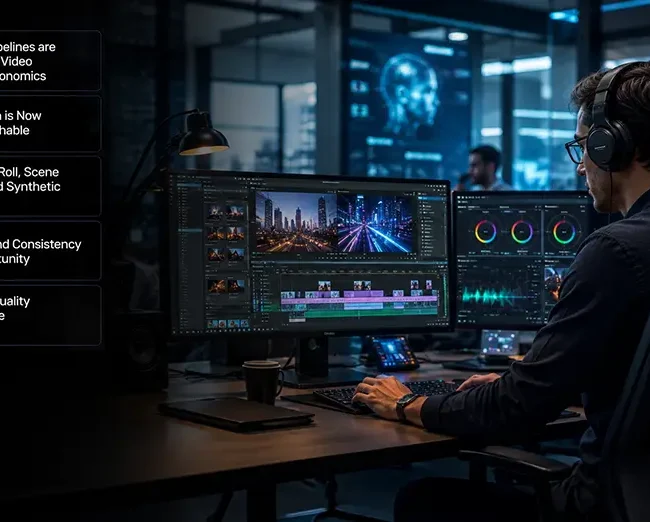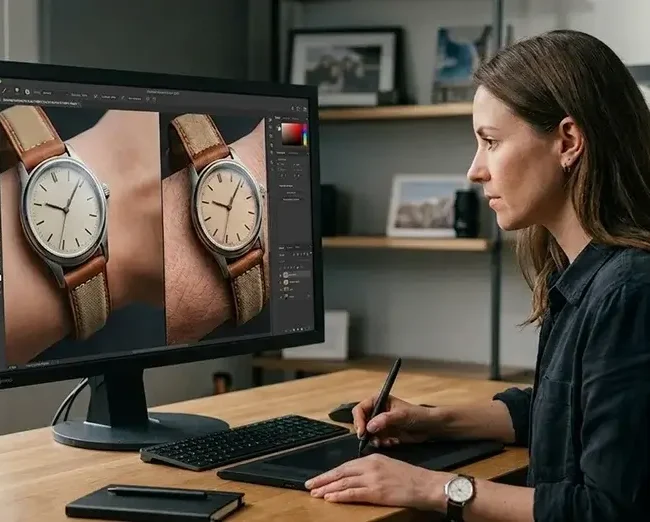
93% of consumers consider visual appearance as a key purchase decision driver, leading to higher conversion rates than poor-quality images.
Visuals and images serve as proxies for product reliability. In a digital-first environment, the choice between AI and human intervention is not merely aesthetics but a strategic decision that impacts long-term brand value.
AI wins on speed and scale, but human retouching is what drives trust, realism, and the brand perception that ultimately converts buyers.
Today, we will look at these through the lens of conversion: which method can bring you more customers?
Why Photo Editing Quality is a Key Metric for Conversion
Beyond aesthetics, image quality functions as a pre-cognitive trust signal. High-fidelity visuals compress the consideration phase of the buyer journey, moving the user from curiosity to intent before they engage with technical specifications.
Before a shopper reads specifications, reviews, or shipping information, image quality determines whether the product feels credible enough to consider.
This ability to ignite curiosity and trust through images affects
- Click-through Rate
- Time on Page
- Add-to-Cart Behavior
- Checkout Completion
On the other hand, poor or misleading visuals create expectation gaps, which surface later as reverse logistics costs. Around 22% of online returns occur because the delivered item looks different from what the buyer expected.
So this makes product image quality important for getting margins, selling products, generating revenue, and not just looking good on screen or paper.
Since every discrepancy can increase the risk of refunds, angry customers, more customer support tickets, and CAC waste, editing images to perfection is necessary.
Where AI Photo Editing Stands Out and Where it Breaks?
The speed of editing is one of the best things about using AI. In high-volume eCommerce workflows, AI performs exceptionally well, especially when the tasks are based on some predefined rules.
AI’s utility lies in its ability to perform repetitive tasks, and that too at speed. By automating background normalization, exposure balancing, batch resizing, clipping paths, and catalog formatting, organizations benefit from rapid SKU expansion without proportional increases in overhead.
For businesses taking thousands of orders through Amazon and Shopify, this visual uniformity enhances listing credibility.
This speed provides a competitive advantage in trend-driven markets, where the time-to-market, the gap between product procurement and live listing, directly impacts how quickly you can capture the market and reduce inventory.
However, AI loses its value when you want to add details that brands use to subconsciously validate authenticity or build an opinion within the customer’s mind.
Here’s an overview of what AI excels at and where it lags.
| AI handles well | AI struggles with |
| Background cleanup at scale | Fine texture fidelity |
| Batch lighting correction | Fabric grain and skin realism |
| White-background compliance | Reflections on glass/metal |
| Simple shadow consistency | Natural shadow physics |
| Bulk catalog formatting | Brand-specific mood direction |
AI editing makes the surface, whether it’s skin, furniture, cloth, jewelry, etc., ultra-smooth. It fails in texture destruction. These small imperfections make some products feel premium, and AI cannot understand their depth and importance.
Then there’s inconsistency in physics. So things like incorrect reflections, unnatural folds, or impossible shadow directions create visual dissonance.
Most importantly, AI optimizes toward visual averages. Conversion, however, is rarely driven by average aesthetics. It is driven by brand-specific perception: warmth, luxury, editorial sharpness, or material realism. That layer remains decisively human.
What Human Retouching Delivers that No Algorithm and AI Tool Can Provide?
A core difference between AI editing and human editing is judgment. Human editors don’t just look at patterns and statistical averages; they are focused on the image’s intent.
Experienced editors deliberately leave the under-eye line, skin creases, grains on premium leather, and more. These small details reinforce authenticity, age, texture, and the product’s perceived value.
It may happen that, if AI recognizes something as an imperfection, humans see it as a trust signal because we work on the basis of intent.
Buyers today don’t just want to see a clean image; they assess it through a different lens.
Is it worth the purchase risk? That’s what buyers aim to identify through images.
Human retouching consistently outperforms AI in quality benchmarks, with recent head-to-head comparisons placing human-edited outputs at 8.85/10, materially above AI averages.
That’s not all: the cost of mistakes is huge, and it’s not just about deteriorating aesthetic appeal. From distorted labels to warped edges and inaccurate shadows, these might be small things AI cannot fix, but human retouching is expensive.
Not to mention the delayed campaigns due to the edits, which adds to the costs.
Another impact where human retouching stands out is lower return rates. When brands preserve color, texture, and scale through human editing, return rates are lower because the expectation gaps narrow down before every repeat purchase.
Industry-Wise Breakdown of AI Photo Editing and Human Retouching
| Industry | Where Each Approach Matters |
| eCommerce and Retail | AI is effective for bulk SKU catalogs and for some general edits, such as white-background standardization and marketplace-ready formatting. But with hero images and PDP-first assets, you need human retouching, especially in categories where visual differentiation is required for higher click-through rates and add-to-cart behavior. |
| Fashion and Apparel | Fabric texture is often a purchase trigger, and AI frequently smooths weave, folds, and material depth, which weakens tactile desirability. Preserving drape realism through human retouching in fashion and apparel mitigates the ‘expectation-reality’ gap, which stabilizes profit margins by reducing the operational strain of reverse logistics and secondary quality inspections. |
| Jewelry | Minute reflections and design patterns control the sale of the product. Moreover, stone brilliance, metal shine, and proportion accuracy are frequent AI failure points. In this category, even subtle reflection errors can materially reduce perceived value. |
| Real Estate | AI works efficiently for staging previews and portfolio consistency across multiple real estate listings. Human editing remains stronger for hero shots that drive inquiries and faster closings. |
| Beauty & Skincare | This is where over-smoothing is most damaging. Buyers actively look for believable skin texture. Human retouching preserves realism while correcting tone imbalance, which protects trust and conversion intent. |
The Decision Matrix | Choosing Between AI Editing, Human Editors, and Outsourcing
The right choice depends less on preference and more on conversion stakes, image volume, and brand positioning.
| Brand / Use Case | Priority | Best Approach |
| High-volume marketplace catalog | Speed + scale | AI |
| Premium PDP / hero images | Conversion + trust | Human |
| Fast-scaling mid-market brands | Scale + QA consistency | Hybrid outsourced |
AI is commercially strongest when you need editing in volume. Editing hundreds of SKUs, seasonal inventory refreshes, and secondary listing assets is best completed with AI-based editing where uniformity matters more than persuasion.
Human retouching delivers stronger ROI when the image itself influences perceived product value, especially in luxury, fashion, beauty, and high-ticket categories.
However, brands have started taking the middle ground, where AI handles first-pass volume processing, while expert human editors and quality experts validate realism, brand consistency, and final conversion readiness.
The hybrid approach reduces headcount pressure, protects turnaround time, and preserves conversion quality at scale.
It is also where managed visual operations partners such as BackOffice Pro fit most naturally, combining automation efficiency with human editorial control on final deliverables.
To Sum it Up
Brands with high conversion rates don’t choose between AI and human retouching, they structure the workflows according to where each adds measurable value.
Hence, the real constraint isn’t capability, but flawless execution at scale because as image volumes grow, maintaining consistency, realism, and brand alignment is harder to manage, especially internally.
The strategic intersection of AI and human craft creates a ‘fail-safe’ workflow: AI handles the labor-intensive baseline, while human intervention acts as the final gatekeeper for brand integrity, ensuring that scale never comes at the cost of perceived market value. For growing brands, the outsourced hybrid model solves the operational bottleneck: AI-led speed with expert human quality control, without adding internal overhead.
If consistent, conversion-ready image output is a growth priority, BackOffice Pro’s image editing team delivers both speed and craft. See how we work.